Special to S & T Review

Generation and development of attosecond light sources

  • Ji WANG , 1, 2 ,
  • Kun ZHAO , 1, 2, *
Expand
  • 1. Beijing National Laboratory for Condensed Matter Physics, Institute of Physics, Chinese Academy of Sciences, Beijing 100190, China
  • 2. Songshan Lake Materials Laboratory, Dongguan 523808, China

Received date: 2023-12-18

  Online published: 2025-04-01

Copyright

All rights reserved. Unauthorized reproduction is prohibited.

Cite this article

Ji WANG , Kun ZHAO . Generation and development of attosecond light sources[J]. Science & Technology Review, 2025 , 43(4) : 19 -29 . DOI: 10.3981/j.issn.1000-7857.2023.12.01810

对瞬态过程的探索可以揭示未知的物理现象,引领人们找到新的物理规律。因此,人们始终在探索具有高时间分辨率的探测手段。1851年是高速摄影的开端[1],此后经过近1个世纪的发展,至1930年世界上出现了第1台基于频闪灯捕捉高速事件瞬间的高速相机[2],使得人们能够捕捉到微秒(1 μs= 10-6 s),甚至纳秒(1 ns=10-9 s)时间尺度内的变化和现象。1960年,激光的出现使人们对时间分辨的掌控飞跃式地提升[3]。1965—1966年,美国贝尔实验室[4]和联合飞行器实验室[5]分别获得了小于1 ns、也就是皮秒(1 ps=10-12 s)量级的激光脉冲。随着调Q、锁模等激光技术的发展[6-8],此后短短15年间,激光的脉冲宽度就从纳秒发展到飞秒(1 fs=10-15 s)量级[9-12]。借助光谱整形、脉冲放大和后压缩等先进激光技术,人们终于获得了小于10 fs的激光脉冲[13-18]。通过超连续光谱展宽,人们进一步获得了低至2.6 fs的少周期,乃至单周期激光脉冲[19],并且相干合成技术进一步将激光脉宽突破至亚飞秒量级[20]
虽然借助皮秒至飞秒的时间分辨,已经能够对分子转动和振动过程等许多超快现象进行观测,但研究原子分子核外电子的运动过程,需要进一步将时间分辨能力提升至阿秒(1 as=10-18 s)量级。目前,处于红外—可见—紫外波段的最短激光脉冲通过相干合成获得,其脉宽为380 as[20]。然而,更短的激光脉冲需要更宽的光谱范围,因此需要寻找将光子能量扩展到极紫外(extreme ultra-violet,XUV)波段的技术。1965年,Keldysh[21]提出了光场中的隧穿电离理论,1987—1988年,McPherson等[22]和Ferray等[23]在激光脉冲与稀有气体相互作用的实验中观察到强场电离下出现的一系列频率为驱动光频率奇数倍的光子辐射,即高次谐波产生(high-order harmonic generation,HHG)。HHG的中心波长可以达到极紫外,甚至软X射线波段,产生宽光谱的HHG极紫外光源,就有可能获得阿秒脉冲。1993年,Corkum[24]提出了强场电离的三步模型理论,成功解释了HHG的诸多特点,描绘了HHG光谱的宏观特征。三步模型揭示出高次谐波产生过程会形成一系列等间距的时域脉冲,每个脉冲的脉宽在阿秒量级,这个脉冲序列称为阿秒脉冲串,并在频域上表现为梳齿状的极紫外光谱。1994年,为解释HHG光谱中精细的干涉结构,Lewenstein等[25]提出了基于量子理论的强场近似理论;同年,Corkum等[26]预言了孤立阿秒脉冲(isolated attosecond pulse,IAP)的产生方法。2001年,Hentschel等[27]首次在实验中观察到孤立阿秒脉冲(脉冲宽度为650 as)。这期间,阿秒条纹相机测量技术的出现和中红外激光及选通技术的改进,逐渐将阿秒脉冲的最短宽度突破到50 as左右[28-29]。当前,阿秒光源已经用于超快动力学研究,实现了对光电离时间延迟、分子内电荷迁移、芯能级的隧道电离等多种超快物理过程的观测[30-34]。由于阿秒光源在物质内部电子动力学研究中的重要实验意义,在阿秒科学领域作出了杰出贡献的Pierre Agostini、Ferenc Krausz和Anne L'Huillier被授予了2023年诺贝尔物理学奖[35]。自阿秒科学诞生以来,中国也有众多科研人员为阿秒科学研究作出贡献。2013年,中国科学院物理研究所首次通过实验测量获得了160 as的孤立阿秒脉冲[36],开创了中国阿秒科学研究的先河。此后,国内也连续报道了一系列孤立阿秒脉冲的实验测量结果[37-41]

1 阿秒脉冲产生

1.1 高次谐波产生

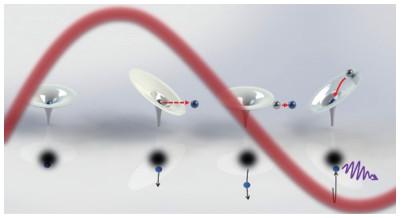
获得脉冲宽度短至阿秒量级的激光脉冲,需要将光源的光子能量扩展到极紫外波段。目前获得阿秒脉冲的主流方法仍是通过气体靶中的高次谐波产生[42]。高次谐波产生的半经典三步模型理论如图 1所示。
图1 高次谐波产生的半经典三步理论模型示意
第一步,高强度低频率激光场通过隧穿电离将相互作用区中气体分子的电子从基态电离到自由态。此过程中,原子的库仑势受激光场的影响而被显著压低,从而使电子有可能通过隧穿电离脱离原子的束缚,驱动激光的强度应为1013~1015 W/cm2[43]。在三步模型中,这一步假设在隧穿电离后,处于连续态的电子初速为0。
第二步,电子波包在驱动激光场中加速,并最终返回到母体离子。此时,离子对电子的影响已经可以忽略不计,电子仅受激光场的加速减速作用。这一过程可以用经典的牛顿力学方程进行描述。
第三步,电子与母体离子重组,产生高次谐波。电子在电场中运动,最终可能回到母体离子的附近,并有一定概率和母体离子重新复合。电子和母体离子可能产生3种相互作用,包括非弹性散射、弹性散射和复合。若电子返回离子并与离子中其他电子发生碰撞,则为非弹性散射,在电子碰撞过程中有概率发生多光子电离。弹性散射则对应电子和离子没有发生实际的能量交换,而在激光场中多次加速。如果电子最终和离子复合后回到基态,则会释放高次谐波光子,其能量为电子返回时的动能与电离能之和。三步模型基于对电子电离和返回时间的分析,给出了高次谐波光子所能达到的最高光子能量Emax=Ip+3.17Up[24],也称截止能量,其中,Ip是原子的电离能,Up为有质动力势,其取决于激光强度(I)和驱动光波长(λ)。由于Up正比于2,使用高强度、长波长的驱动光源可以得到更高光子能量的高次谐波。但同时,高次谐波的产生效率和驱动光波长约有ηHHG~λ-6的关系[44-46],故若要获得高通量的高次谐波,反而需要使用更短的驱动光波长或使用双色驱动场[47]
阿秒光源在相干衍射成像和阿秒非线性光学研究等前沿科学领域都有重要作用[48-50]。然而,阿秒光源的低通量使得在这些需要较高光子通量的应用中很难发挥作用。为了获得高通量的高次谐波,人们发展了许多实验方法。高次谐波本身是非常高阶的非线性过程,因此和其他非线性过程类似,相位匹配在提高产生效率方面能够发挥重要作用。高次谐波的相位匹配条件可表达为[51-52]
$\Delta k=\Delta k_{\text {Gouy }}+\Delta k_{\text {Dispersion }}+\Delta k_{\text {Dipole }}$
式中,ΔkGouy为聚焦引起的几何波矢失配,ΔkDispersion为气体介质和自由电子带来的色散,ΔkDipole为强度依赖的偶极相位项。几何波矢失配项可以表示为[53]
$\Delta k_{\text {Gouy }}=q \frac{\partial \varphi_{\text {Gouy }}}{\partial z}=q \frac{\partial}{\partial z}\left(-\arctan \left(\frac{z}{z_0}\right)\right)$
式中,q为高次谐波阶次,z为激光传播距离,z0为激光焦点位置。色散项中包含了源自于中性原子和等离子体的色散,两者带来的波矢失配符号相反。这一项可以表示为[54]
$\Delta k_{\text {Dispersion }}=\frac{2 \mathsf{π} q}{\lambda} \frac{p}{\mathrm{p}_0} \Delta \delta\left(1-\frac{\eta}{\eta_{\mathrm{c}}}\right)$
式中,p和p0分别是作用区域气压和标准大气压,Δδ是基频光和高次谐波之间的介质折射率差,ηηc分别是电离分数和临界电离分数。临界电离分数指电子色散超过原子色散时的电离比例。偶极相位带来的波矢失配可以表示为[55]
$\Delta k_{\text {Dipole }}=-\alpha_{\mathrm{q}} \frac{\partial I}{\partial z}$
式中,I为激光场功率密度。
对于三步模型中的短轨道,传播常数αq为正。几何失配和偶极相位失配的符号相同,故一般使用色散项对波矢失配进行补偿,通过调节气体靶气压实现相位匹配。在激光焦点位置,偶极相位失配为0,如果此时电离比例超过了临界电离分数,则无法使用调节气压的方法实现短轨道的相位匹配条件[56],因此,通常将作用区域放在激光焦点之后。在进行一般的高次谐波产生实验时,为了达到产生高次谐波所需的场强,有时需要紧聚焦,而紧聚焦时几何相移更大,需要更高的气压才能实现相位匹配。产生高通量的阿秒光源需使用强度足够高的驱动激光,松聚焦条件下几何相移较小,可以更容易地达到相位匹配条件;同时松聚焦条件下瑞利距离较长,因此,激光与气体的相互作用距离可以比较长,从而提高高次谐波的转化效率。

1.2 孤立阿秒脉冲产生及选通技术
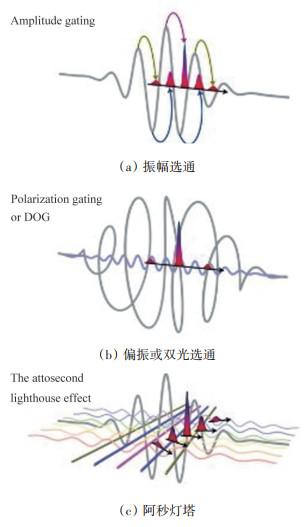
驱动激光的每半个光周期会产生一次高次谐波,这些高次谐波彼此干涉,在频域上表现为一系列梳齿状的光谱,对应在时域上表现为阿秒脉冲的序列,称为阿秒脉冲串。阿秒泵浦-探测实验通常需要使用孤立阿秒脉冲,即通过合适的选通方法,从阿秒脉冲序列中选出单个脉冲,常用的几种选通方式如图 2所示[57]
图2 3种选通方式的原理示意
产生孤立阿秒脉冲最常用的方式是振幅选通,这种方法需要载波包络相位(carrier-envelope phase,CEP)稳定的少周期,甚至单周期飞秒激光作为高次谐波的驱动源。其高次谐波光谱在高能部分由于不存在干涉,表现为连续谱,连续谱部分对应单个阿秒脉冲。振幅选通使用金属膜等过滤出高次谐波的高能连续谱部分,从而得到孤立阿秒脉冲。国内首个孤立阿秒脉冲是中国科学院物理研究所利用CEP稳定的亚5 fs钛宝石激光结合振幅选通得到的160 as脉冲[36]。目前最短阿秒脉冲的世界纪录43 as也是利用振幅选通技术[29],使用脉宽11.5 fs、中心波长1.8 μm的驱动激光产生。
偏振选通则使用了另一种原理。高次谐波在线偏振驱动光的情况下效率最高,圆偏振驱动光的产生效率则很低。利用高次谐波这一特性,Tcherbakoff等[58]设计了如下方案:首先使用特定厚度的石英片将沿光轴45°入射的线偏振飞秒脉冲分解为水平偏振和竖直偏振2个分量,并让水平偏振和竖直偏振的脉冲在时间上几乎完全分开。而后2个脉冲先后通过同一个零级四分之一波片,水平偏振和竖直偏振分量通过波片后分别变为左(右)旋偏振光和右(左)旋偏振光,只有2个脉冲在时间上重叠部分在入射前是45°线偏光,经过四分之一波片后仍为线偏光。调节2个偏振分量的分离时间,使得它们只重合半个光周期,就可以用来产生孤立的阿秒脉冲。偏振选通不要求驱动激光压缩至少周期量级,放宽了孤立阿秒脉冲的获取条件,目前已有大量实验通过偏振选通获得了孤立阿秒脉冲[28, 59-61]。但偏振选通制备的驱动光,其线偏振区域内的场强较低,因此,高次谐波的转化效率较低[62-63]
2007年,Merdji等[64]发明了一种在较长光周期范围内产生单阿秒脉冲的方法,称为双色选通。此方法使用一束基频驱动光和它的倍频光形成双色驱动场,通过调节基频光和倍频光的延迟控制光场形状,使得原本每半个光周期产生1个阿秒脉冲变为每2.5个光周期才产生1个。对于更长的驱动光脉冲,仅使用双色选通仍然会产生多个阿秒脉冲,所以通常将双色场与偏振选通方法结合,即双光选通[38, 39, 65-71]。双光选通不需要如偏振选通那般精密的延迟调节,可以将基频光的脉冲宽度放宽至12 fs。目前许多脉宽接近和突破100 as的实验结果是在双光选通下完成的[39, 65, 71-73],甚至在门控区间延长至接近1 fs时,还能够使用CEP非稳定的驱动激光产生单个阿秒脉冲[39]。之后发展出的广义双光选通方法[69, 74-75]在双光选通中加入一个布儒斯特窗片,将原本的圆偏振光变为椭圆偏振,减少了在线偏光到来前的原子电离,将基频光的脉宽要求进一步放宽到了28~30 fs。
2013年,Kim等[76]发现如果使用带有波前倾斜的驱动光产生高次谐波,阿秒脉冲串中的每个阿秒脉冲也会沿不同方向发射,由此可以分离出单个阿秒脉冲,此方法称为阿秒灯塔。这一方法是在空间上将孤立阿秒脉冲选出,因此是一种空间选通方法。2016年,Hammond等[77]用这一方法截取了3个阿秒脉冲,并测量了其脉宽。

2 阿秒光源的进展和发展趋势

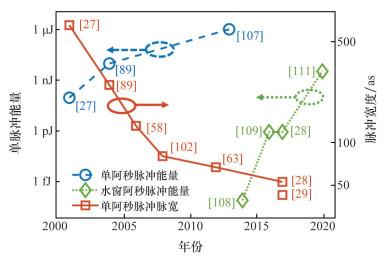
阿秒光源已广泛应用于电子动力学研究,如观测阿秒尺度的能隙变化和电子散射过程[78],原子分子物理研究,如阿秒瞬态吸收光谱[34, 69-70, 79-85]、微观化学反应过程研究[83]及生物学研究如氨基酸分子内电荷迁移[33]等,甚至有希望解决电子隧穿时间等量子力学基本问题[86-88]。自阿秒科学诞生以来,对于更高参数的阿秒光源和对阿秒光源应用的探索一直都在同时进行,其参数发展如图 3所示。
图3 最短单阿秒脉冲(红色实线)、最高单阿秒脉冲能量(蓝色虚线)、最高水窗波段阿秒脉冲能量(绿色点线)的发展历史
2001年,Hentschel等[27]获得了世界上第1个阿秒脉冲,脉冲宽度为650 as,单脉冲能量约为0.1 nJ。同年,Paul等[30]用双光子跃迁干涉阿秒拍频重建(reconstruction of attosecond beating by interference of two-photon transitions,RABBITT)方法实现了阿秒脉冲串的测量。RABBITT方法基于双光子跃迁干涉,因此也能够用来重建原子的电离过程。如2017年Isinger等[89]使用RABBITT重建了Ne原子2s和2p轨道的电离过程。
2002年,Itatani等[90]提出了阿秒条纹相机的概念,Mairesse等[91]在此基础上提出了反演阿秒脉冲的FROG-CRAB(frequency-resolved optical gating for complete reconstruction of attosecond bursts)方法,此后阿秒条纹相机广泛应用于阿秒脉冲测量。2004年,Kienberger等[92]得到了250 as的单阿秒脉冲,并将阿秒脉冲的单脉冲能量提升至10 nJ量级,之后Sansone等[60]将阿秒脉冲的脉宽缩短至130 as。2007年,Cavalieri等[93]使用脉宽300 as的阿秒光源,通过阿秒条纹相机研究了金属钨在导带和4f态的电离时间差问题。自此,众多研究人员使用阿秒条纹相机对电离问题展开研究[93-103]。使用阿秒光源和阿秒条纹相机这2大工具,不仅可以进行电离问题的探索,还可以研究材料的动力学导电性。Garg等[104]使用阿秒条纹相机研究了高强度单周期激光脉冲引发的玻璃动力学导电特性,为高速光电器件的发展提供了理论和实验支撑,说明阿秒光源不仅是研究基础物理的工具,也能够在先进器件发展方面提供助力。
2008年,Goulielmakis等[105]得到了脉冲宽度仅为80 as的孤立阿秒脉冲。次年,他们在原本飞秒极紫外瞬态吸收光谱[106-108]的基础上发展了阿秒瞬态吸收光谱这一谱学研究技术,首次实现了对飞秒尺度下价电子运动的实时观测[109]。阿秒瞬态吸收光谱使得人们能够实时观测原子、分子以及固体材料中的电子微观运动。此后,Zhao等[65]进一步将阿秒脉冲的最短宽度突破至67 as,Takahashi等[110]使用双色场将阿秒脉冲的单脉冲能量提高到了μJ量级。
2014年,Rothhardt等[111]将高次谐波的波段拓展至水窗,其单脉冲能量在0.1 fJ量级,光子通量为105光子数/s,最高光子能量达到了350 eV。2016年,Teichmann等[112]获得了光子能量覆盖整个水窗波段200~500 eV的软X射线超连续光谱,单脉冲能量达到pJ量级,最高光子通量可以达到2.8×10⁷光子数/s。2017年,Li等[28]得到了53 as的孤立阿秒脉冲测量结果,其光子能量进入水窗波段,达到了300 eV,单脉冲能量达到10 pJ量级,阿秒光子通量达到了5×10⁸光子数/s,水窗波段的脉冲能量接近pJ量级。同年,Gaumnitz等[29]得到了43 as的孤立阿秒脉冲测量结果,是目前最短的阿秒脉冲世界纪录。次年,Johnson等[113]得到了水窗波段软X射线高次谐波,最高光子能量可以达到600 eV。水窗波段的宽光谱阿秒光源[34, 82-83, 85]使得探测分子尺度下的微观化学反应路径[83],以及研究材料表面载流子运动[84]等微观超快过程成为可能。
2020年,Fu等[114]得到了单脉冲能量达到3.5 nJ的水窗波段高次谐波,是目前单脉冲能量最高的水窗波段高次谐波。同年,Huijts等[115]应用宽带极紫外光源实现了相干衍射成像,证明了阿秒光源有可能在未来实现阿秒时间分辨与纳米空间分辨的高精度探测。
未来的阿秒光源需要朝向产生更高光子能量、更短脉宽、更高单脉冲能量、更高光子通量和更高重复频率的孤立阿秒脉冲发展。光子能量达到keV以上的阿秒光源有希望在阿秒时间分辨率和原子空间分辨率下研究物质中的强成键作用[116-117]、脉冲宽度达到阿秒甚至仄秒(1 zs=10-21 s)量级的超短脉冲能够捕捉到原子核内的核子运动[118]、强度可以达到109~1016 W/cm2的阿秒光源将能够进行阿秒非线性光学的研究[119-121]、光子通量达到1013光子数/s的光源可用于X射线光谱学和成像学实验[122];并且重复频率达到1 MHz的高重复频率的阿秒光源可以避免光电子的聚集[123-124],在复合光谱学研究中具有重要意义[125-126]。获得高光子能量和短脉冲的阿秒光源,需要发展长波长的驱动激光并优化气体靶结构实现更好的相位匹配[127];获得高光子通量的阿秒光源则需要发展短波长驱动激光并优化高次谐波产生方案[110, 128];在此基础上提高阿秒光源的重复频率则需要重复频率更高的驱动激光或设计新的光路结构如共振增强腔[129],并需要高重复频率、高平均功率的飞秒激光器作为支撑[130]。阿秒光源的进一步发展,涉及阿秒科学和超快激光研究的方方面面。阿秒光源在近20年飞速发展,表现出广泛应用前景。国内外众多实验机构均搭建了阿秒装置[36, 38-39, 66, 131],为阿秒科学的进步贡献了力量。然而针对目前众多实验需求和未来的诸多探索,桌面级的小型阿秒光源在光源参数和应用条件上已经不能满足复杂的实验需求,建设大型阿秒装置,实现高性能的阿秒综合实验研究迫在眉睫。
目前国际上已有数个大型阿秒装置计划建设或在建。其中,欧洲首先开始建设的极端光设施阿秒激光装置(extreme light infrastructure attosecond light pulse source, ELI-ALPS)[132]已经部分建成。ELI-ALPS装置提供了从峰值功率0.1 TW(1 TW=1012 W)、重复频率100 kHz的高重频飞秒驱动光源到峰值功率达到PW(1 PW=1015 W)量级的驱动光源[133],脉冲宽度从小于2光周期到小于20 fs。其SYLOS GHHG-COMPACT束线提供中心光子能量40 eV,脉宽3~4 fs的阿秒脉冲串,功率密度达到1012 W/cm2,可用于非线性光学过程如双光子电离的测量[134]。SYLOS Long GHHG束线使用了长达20 m的聚焦产生高次谐波,提供300 nJ以上的XUV输出[135],可进行RABBITT实验。HR GHHG Gas束线提供100 kHz的高重频高次谐波光源,平均功率可达60 μW[136-139],可用于冷靶反冲离子动量谱仪(cold target recoil ion momentum spectrometer, COLTRIMS)和速度成像谱仪(velocity map imaging,VMI)等实验。此外,ELI-ALPS还提供包含软X射线和太赫兹束线在内的多个束线和应用终端。除此之外,美国的俄亥俄州立大学也在进行美国极端超快科学设施NeXUS(national extreme ultrafast science)的建设[140],日本也在计划建设阿秒激光设施ALFA(attosecond laser facility)来提供前沿的用户研究装置[141]
国内的综合极端条件用户装置(synergetic extreme condition user facility, SECUF)中的阿秒子系统是建设综合性阿秒光源装置的探路者[142],提供从脉宽小于100 as的孤立阿秒脉冲到高重频极紫外高次谐波的多种光源及瞬态吸收光谱、COLTRIMS、光发射电子显微镜(photoemission electron microscopy,PEEM)、角分辨光电子能谱仪(angle-resolved photoelectron spectroscopy,ARPES)等多个实验终端。在未来的大型阿秒装置中,阿秒光源的综合指标有望发展到脉冲宽度小于30 as、单脉冲能量大于10 μJ、中心光子能量达到水窗波段,并且具有更高的重复频率。使用这样高性能的阿秒光源,研究人员将能够对新的基本物理问题展开探索。

3 结论

近20年阿秒科学正在飞速发展,阿秒脉冲的宽度不断缩短、阿秒脉冲的光子能量和单脉冲能量都不断提高、阿秒光源的重复频率和平均功率也在逐步提升。现在人们已经能够获得脉冲宽度小于50 as或最高光子能量达到600 eV或单脉冲能量超过nJ量级的阿秒光源。与此同时,人们也在不断探索阿秒光源的应用,RABBITT和阿秒条纹相机不仅可以实现阿秒脉冲串和单个阿秒脉冲的测量,还能够用来进行原子电离过程的实时观测;阿秒瞬态吸收光谱实现了对固体内部微观运动的探索,配合水窗波段的阿秒光源更可以实现化学反应路径的微观观测,将阿秒科学研究进一步向化学和生物领域拓展。针对日益复杂的阿秒实验需求,世界各地正在兴建大型阿秒科学装置,未来在这些阿秒科学装置中,势必产生更高品质的阿秒光源,进而能够在阿秒时间尺度和原子空间尺度下对世界展开新的探索。

1
Shapiro S L. Introduction: A historical overview[M]//Shapiro S L, ed. Topics in Applied Physics. Berlin, Heidelberg: Springer Berlin Heidelberg, 1977: 1-15.

2
Edgerton H E . Electronic flash, strobe (3rd edition)[M]. Cambridge: The MIT Press, 1987.

3
Maiman T H . Stimulated optical radiation in ruby[J]. Nature, 1960, 187: 493- 494.

DOI

4
Crowell M H . Characteristics of mode-coupled lasers[J]. IEEE Journal of Quantum Electronics, 1965, 1 (1): 12- 20.

DOI

5
DeMaria A J , Stetser D A , Heynau H . Self mode-locking of lasers with saturable absorbers[J]. Applied Physics Letters, 1966, 8 (7): 174- 176.

DOI

6
Mocker H W , Collins R J . Mode competition and self-locking effects in a q-switched ruby laser[J]. Applied Physics Letters, 1965, 7 (10): 270- 273.

DOI

7
Hargrove L E , Fork R L , Pollack M A . Locking of He-Ne laser modes induced by synchronous intracavity modulation[J]. Applied Physics Letters, 1964, 5 (1): 4- 5.

DOI

8
Ippen E P , Shank C V , Dienes A . Passive mode locking of the cw dye laser[J]. Applied Physics Letters, 1972, 21 (8): 348- 350.

DOI

9
Shank C V , Ippen E P . Subpicosecond kilowatt pulses from a mode-locked cw dye laser[J]. Applied Physics Letters, 1974, 24 (8): 373- 375.

DOI

10
孙文山, 林世雄. 阿秒光谱技术的探讨[J]. 光学技术, 1985, 11 (3): 14- 15.

11
Agostini P , DiMauro L F . The physics of attosecond light pulses[J]. Reports on Progress in Physics, 2004, 67 (8): 1563.

DOI

12
赵昆. 激光、啁啾脉冲放大、超快光学和诺贝尔奖[J]. 科学通报, 2019, 64 (14): 1433- 1440.

13
Fork R L , Cruz C H , Becker P C , et al. Compression of optical pulses to six femtoseconds by using cubic phase compensation[J]. Optics Letters, 1987, 12 (7): 483- 485.

14
Nisoli M , De Silvestri S , Svelto O . Generation of high energy 10 fs pulses by a new pulse compression technique[J]. Applied Physics Letters, 1996, 68 (20): 2793- 2795.

DOI

15
Liu H , Wang G Y , Jiang J W , et al. Sub-10-fs pulse generation from a blue laser-diode-pumped Ti: Sapphire oscillator[J]. Chinese Optics Letters, 2020, 18 (7): 071402.

DOI

16
Sutter D H , Steinmeyer G , Gallmann L , et al. Semiconductor saturable-absorber mirror assisted Kerr-lens modelocked Ti: Sapphire laser producing pulses in the two-cycle regime[J]. Optics Letters, 1999, 24 (9): 631- 633.

DOI

17
He P , Liu Y Y , Zhao K , et al. High-efficiency supercontinuum generation in solid thin plates at 0.1 TW level[J]. Optics Letters, 2017, 42 (3): 474- 477.

DOI

18
Huang P , Fang S B , Gao Y T , et al. Simple method for simultaneous long-term stabilization of relative timing and carrier-envelope phase in waveform synthesis[J]. Applied Physics Letters, 2019, 115 (3): 031102.

DOI

19
Silva F , Alonso B , Holgado W , et al. Strategies for achieving intense single-cycle pulses with in-line post-compression setups[J]. Optics Letters, 2018, 43 (2): 337- 340.

20
Hassan M T , Luu T T , Moulet A , et al. Optical attosecond pulses and tracking the nonlinear response of bound electrons[J]. Nature, 2016, 530 (7588): 66- 70.

DOI

21
Keldysh L V . Ionization in the field of a strong electromagnetic wave[J]. Soviet Physics-JETP, 1965, 20 (5): 1307.

22
McPherson A , Gibson G , Jara H , et al. Studies of multiphoton production of vacuum-ultraviolet radiation in the rare gases[J]. Journal of the Optical Society of America B, 1987, 4 (4): 595.

DOI

23
Ferray M , L'Huillier A , Li X F , et al. Multiple-harmonic conversion of 1064 nm radiation in rare gases[J]. Journal of Physics B: Atomic, Molecular and Optical Physics, 1988, 21 (3): L31- L35.

DOI

24
Corkum P B . Plasma perspective on strong field multiphoton ionization[J]. Physical Review Letters, 1993, 71 (13): 1994- 1997.

DOI

25
Lewenstein M , Balcou P H , Ivanov M Y , et al. Theory of high-harmonic generation by low-frequency laser fields[J]. Physical Review A, 1994, 49 (3): 2117- 2132.

DOI

26
Corkum P B , Burnett N H , Ivanov M Y . Subfemtosecond pulses[J]. Optics Letters, 1994, 19 (22): 1870- 1872.

DOI

27
Hentschel M , Kienberger R , Spielmann C H , et al. Attosecond metrology[J]. Nature, 2001, 414: 509- 513.

DOI

28
Li J , Ren X M , Yin Y C , et al. 53-attosecond X-ray pulses reach the carbon K-edge[J]. Nature Communications, 2017, 8 (1): 186.

29
Gaumnitz T , Jain A , Pertot Y , et al. Streaking of 43-attosecond soft-X-ray pulses generated by a passively CEP-stable mid-infrared driver[J]. Optics Express, 2017, 25 (22): 27506- 27518.

DOI

30
Paul P M , Toma E S , Breger P , et al. Observation of a train of attosecond pulses from high harmonic generation[J]. Science, 2001, 292 (5522): 1689- 1692.

DOI

31
Muller H G . Reconstruction of attosecond harmonic beating by interference of two-photon transitions[J]. Applied Physics B, 2002, 74 (1): s17- s21.

32
Klünder K , Dahlström J M , Gisselbrecht M , et al. Probing single-photon ionization on the attosecond time scale[J]. Physical Review Letters, 2011, 106 (14): 143002.

DOI

33
Calegari F , Ayuso D , Trabattoni A , et al. Ultrafast electron dynamics in phenylalanine initiated by attosecond pulses[J]. Science, 2014, 346 (6207): 336- 339.

DOI

34
Saito N , Douguet N , Sannohe H , et al. Attosecond electronic dynamics of core-excited states of N2O in the soft x-ray region[J]. Physical Review Research, 2021, 3 (4): 043222.

35
赵昆. 阿秒光学简史: 2023年度诺贝尔物理学奖背后的故事[J]. 科学通报, 2023, 68 (36): 4918- 4926.

36
Zhan M J , Ye P , Teng H , et al. Generation and measurement of isolated 160-attosecond XUV laser pulses at 82 eV[J]. Chinese Physics Letters, 2013, 30 (9): 093201.

DOI

37
王向林, 徐鹏, 李捷, 等. 利用自研阿秒条纹相机测得159 as孤立阿秒脉冲[J]. 中国激光, 2020, 47 (4): 329- 332.

38
Yang Z , Cao W , Chen X , et al. All-optical frequency-resolved optical gating for isolated attosecond pulse reconstruction[J]. Optics Letters, 2020, 45 (2): 567- 570.

DOI

39
Wang X W , Wang L , Xiao F , et al. Generation of 88 as isolated attosecond pulses with double optical gating[J]. Chinese Physics Letters, 2020, 37 (2): 023201.

DOI

40
Zhong S Y , Teng H , Zhu X X , et al. Characterizing 86-attosecond isolated pulses based on amplitude gating of high harmonic generation[J]. Chinese Optics Letters, 2023, 21 (11): 113201.

DOI

41
Wang J C , Xiao F , Wang L , et al. Fast phase retrieval for broadband attosecond pulse characterization[J]. Optics Express, 2023, 31 (26): 43224- 43233.

DOI

42
Wei Z Y , Xu S Y , Jiang Y J , et al. Principle and progress of attosecond pulse generation[J]. Chinese Science Bulletin, 2021, 66 (8): 889- 901.

DOI

43
Klaiber M , Hatsagortsyan K Z , Keitel C H . Fully relativistic laser-induced ionization and recollision processes[J]. Physical Review A, 2007, 75 (6): 063413.

DOI

44
Tate J , Auguste T , Muller H G , et al. Scaling of wavepacket dynamics in an intense midinfrared field[J]. Physical Review Letters, 2007, 98 (1): 013901.

DOI

45
Colosimo P , Doumy G , Blaga C I , et al. Scaling strongfield interactions towards the classical limit[J]. Nature Physics, 2008, 4: 386- 389.

DOI

46
Shiner A D , Trallero-Herrero C , Kajumba N , et al. Wavelength scaling of high harmonic generation efficiency[J]. Physical Review Letters, 2009, 103 (7): 073902.

DOI

47
Cirmi G , Lai C J , Huang S W , et al. Tunable high harmonic generation driven by a visible optical parametric amplifier[J]. EPJ Web of Conferences, 2013, 41: 01002.

DOI

48
Ravasio A , Gauthier D , Maia F R N C , et al. Single-shot diffractive imaging with a table-top femtosecond soft X-ray laser-harmonics source[J]. Physical Review Letters, 2009, 103 (2): 028104.

DOI

49
Sekikawa T , Kosuge A , Kanai T , et al. Nonlinear optics in the extreme ultraviolet[J]. Nature, 2004, 432 (7017): 605- 608.

DOI

50
Manschwetus B , Rading L , Campi F , et al. Two-photon double ionization of Neon using an intense attosecond pulse train[J]. Physical Review A, 2016, 93 (6): 061402.

DOI

51
魏志义, 钟诗阳, 贺新奎, 等. 阿秒光学进展及发展趋势[J]. 中国激光, 2021, 48 (5): 9- 24.

52
Rothhardt J , Krebs M , Hädrich S , et al. Absorption-limited and phase-matched high harmonic generation in the tight focusing regime[J]. New Journal of Physics, 2014, 16 (3): 033022.

DOI

53
Lewenstein M , Salières P , L'Huillier A . Phase of the atomic polarization in high-order harmonic generation[J]. Physical Review A, 1995, 52 (6): 4747- 4754.

DOI

54
Popmintchev T , Chen M C , Bahabad A , et al. Phase matching of high harmonic generation in the soft and hard X-ray regions of the spectrum[J]. Proceedings of the National Academy of Sciences of the United States of America, 2009, 106 (26): 10516- 10521.

55
Paul A , Gibson E A , Zhang X , et al. Phase-matching techniques for coherent soft X-ray generation[J]. IEEE Journal of Quantum Electronics, 2006, 42 (1): 14- 26.

DOI

56
Heyl C M , Güdde J , L'Huillier A , et al. High-order harmonic generation with μJ laser pulses at high repetition rates[J]. Journal of Physics B: Atomic, Molecular and Optical Physics, 2012, 45 (7): 074020.

DOI

57
Chini M , Zhao K , Chang Z H . The generation, characterization and applications of broadband isolated attosecond pulses[J]. Nature Photonics, 2014, 8: 178- 186.

DOI

58
Tcherbakoff O , Mével E , Descamps D , et al. Time-gated high-order harmonic generation[J]. Physical Review A, 2003, 68 (4): 043804.

DOI

59
Chang Z H . Single attosecond pulse and xuv supercontinuum in the high-order harmonic plateau[J]. Physical Review A, 2004, 70 (4): 043802.

DOI

60
Sansone G , Benedetti E , Calegari F , et al. Isolated singlecycle attosecond pulses[J]. Science, 2006, 314 (5798): 443- 446.

DOI

61
Sola I J , Mével E , Elouga L , et al. Controlling attosecond electron dynamics by phase-stabilized polarization gating[J]. Nature Physics, 2006, 2: 319- 322.

DOI

62
Sansone G , Poletto L , Nisoli M . High-energy attosecond light sources[J]. Nature Photonics, 2011, 5: 655- 663.

DOI

63
Chang Z H . Chirp of the single attosecond pulse generated by a polarization gating[J]. Physical Review A, 2005, 71 (2): 023813.

DOI

64
Merdji H , Auguste T , Boutu W , et al. Isolated attosecond pulses using a detuned second-harmonic field[J]. Optics Letters, 2007, 32 (21): 3134- 3136.

DOI

65
Zhao K , Zhang Q , Chini M , et al. Tailoring a 67 attosecond pulse through advantageous phase-mismatch[J]. Optics Letters, 2012, 37 (18): 3891- 3893.

DOI

66
Wang X L , Xu P , Li J , et al. Isolated attosecond pulse with 159 as duration measured by home built attosecond streaking camera[J]. Chinese Journal of Lasers, 2020, 47 (4): 0415002.

DOI

67
Chang Z H . Controlling attosecond pulse generation with a double optical gating[J]. Physical Review A, 2007, 76 (5): 051403.

DOI

68
Mashiko H , Gilbertson S , Li C Q , et al. Double optical gating of high-order harmonic generation with carrier-envelope phase stabilized lasers[J]. Physical Review Letters, 2008, 100 (10): 103906.

DOI

69
Feng X M , Gilbertson S , Mashiko H , et al. Generation of isolated attosecond pulses with 20 to 28 femtosecond lasers[J]. Physical Review Letters, 2009, 103 (18): 183901.

DOI

70
Mashiko H , Bell M J , Beck A R , et al. Tunable frequency-controlled isolated attosecond pulses characterized by either 750 nm or 400 nm wavelength streak fields[J]. Optics Express, 2010, 18 (25): 25887- 25895.

DOI

71
Li J , Chew A , Hu S Y , et al. Double optical gating for generating high flux isolated attosecond pulses in the soft X-ray regime[J]. Optics Express, 2019, 27 (21): 30280- 30286.

DOI

72
Mashiko H , Gilbertson S , Chini M , et al. Extreme ultraviolet supercontinua supporting pulse durations of less than one atomic unit of time[J]. Optics Letters, 2009, 34 (21): 3337- 3339.

DOI

73
Gilbertson S , Mashiko H , Li C Q , et al. A low-loss, robust setup for double optical gating of high harmonic generation[J]. Applied Physics Letters, 2008, 92 (7): 071109.

DOI

74
Gilbertson S , Wu Y , Khan S D , et al. Isolated attosecond pulse generation using multicycle pulses directly from a laser amplifier[J]. Physical Review A, 2010, 81 (4): 043810.

DOI

75
Mashiko H , Oguri K , Sogawa T . Attosecond pulse generation in carbon K-edge region (284 eV) with sub-250 μJ driving laser using generalized double optical gating method[J]. Applied Physics Letters, 2013, 102 (17): 171111.

DOI

76
Kim K T , Zhang C M , Ruchon T , et al. Photonic streaking of attosecond pulse trains[J]. Nature Photonics, 2013, 7: 651- 656.

DOI

77
Hammond T J , Brown G G , Kim K T , et al. Attosecond pulses measured from the attosecond lighthouse[J]. Nature Photonics, 2016, 10: 171- 175.

DOI

78
Schultze M , Ramasesha K , Pemmaraju C D , et al. Attosecond band-gap dynamics in silicon[J]. Science, 2014, 346 (6215): 1348- 1352.

79
Chen S H , Bell M J , Beck A R , et al. Light-induced states in attosecond transient absorption spectra of laser-dressed helium[J]. Physical Review A, 2012, 86 (6): 063408.

DOI

80
Wang X W , Chini M , Cheng Y , et al. In situ calibration of an extreme ultraviolet spectrometer for attosecond transient absorption experiments[J]. Applied Optics, 2013, 52 (3): 323- 329.

DOI

81
Cheng Y , Chini M , Wang X W , et al. Reconstruction of an excited-state molecular wave packet with attosecond transient absorption spectroscopy[J]. Physical Review A, 2016, 94 (2): 023403.

DOI

82
Saito N , Sannohe H , Ishii N , et al. Real-time observation of electronic, vibrational, and rotational dynamics in nitric oxide with attosecond soft X-ray pulses at 400 eV[J]. Optica, 2019, 6 (12): 1542.

DOI

83
Pertot Y , Schmidt C , Matthews M , et al. Time-resolved X-ray absorption spectroscopy with a water window high-harmonic source[J]. Science, 2017, 355 (6322): 264- 267.

DOI

84
Buades B , Picón A , Berger E , et al. Attosecond state-resolved carrier motion in quantum materials probed by soft X-ray XANES[J]. Applied Physics Reviews, 2021, 8 (1): 011408.

DOI

85
Chew A , Douhuet N , Cariker C , et al. Attosecond transient absorption spectrum of argon at the L2, 3 edge[J]. Physical Review A, 2018, 97 (3): 031407.

DOI

86
Landsman A S , Weger M , Maurer J , et al. Ultrafast resolution of tunneling delay time[J]. Optica, 2014, 1 (5): 343- 349.

DOI

87
Sainadh U S , Xu H , Wang X S , et al. Attosecond angular streaking and tunnelling time in atomic hydrogen[J]. Nature, 2019, 568 (7750): 75- 77.

DOI

88
Ramos R , Spierings D , Racicot I , et al. Measurement of the time spent by a tunnelling atom within the barrier region[J]. Nature, 2020, 583 (7817): 529- 532.

DOI

89
Isinger M , Squibb R J , Busto D , et al. Photoionization in the time and frequency domain[J]. Science, 2017, 358 (6365): 893- 896.

DOI

90
Itatani J , Quéré F , Yudin G L , et al. Attosecond streak camera[J]. Physical Review Letters, 2002, 88 (17): 173903.

DOI

91
Mairesse Y , Quéré F . Frequency-resolved optical gating for complete reconstruction of attosecond bursts[J]. Physical Review A, 2005, 71: 011401.

DOI

92
Kienberger R , Goulielmakis E , Uiberacker M , et al. Atomic transient recorder[J]. Nature, 2004, 427 (6977): 817- 821.

DOI

93
Cavalieri A L , Müller N , Uphues T , et al. Attosecond spectroscopy in condensed matter[J]. Nature, 2007, 449 (7165): 1029- 1032.

DOI

94
Schultze M , Fiess M , Karpowicz N , et al. Delay in photoemission[J]. Science, 2010, 328 (5986): 1658- 1662.

DOI

95
Nagele S , Pazourek R , Feist J , et al. Time-resolved photoemission by attosecond streaking: Extraction of time information[J]. Journal of Physics B: Atomic, Molecular and Optical Physics, 2011, 44 (8): 081001.

DOI

96
Neppl S , Ernstorfer R , Bothschafter E M , et al. Attosecond time-resolved photoemission from core and valence states of magnesium[J]. Physical Review Letters, 2012, 109 (8): 087401.

DOI

97
Förg B , Schötz J , Süßmann F , et al. Attosecond nanoscale near-field sampling[J]. Nature Communications, 2016, 7: 11717.

DOI

98
Sabbar M , Heuser S , Boge R , et al. Resonance effects in photoemission time delays[J]. Physical Review Letters, 2015, 115 (13): 133001.

DOI

99
Ossiander M , Siegrist F , Shirvanyan V , et al. Attosecond correlation dynamics[J]. Nature Physics, 2017, 13: 280- 285.

DOI

100
Siek F , Neb S , Bartz P , et al. Angular momentum-induced delays in solid-state photoemission enhanced by intra-atomic interactions[J]. Science, 2017, 357 (6357): 1274- 1277.

DOI

101
Ossiander M , Riemensberger J , Neppl S , et al. Absolute timing of the photoelectric effect[J]. Nature, 2018, 561 (7723): 374- 377.

DOI

102
Biswas S , Förg B , Ortmann L , et al. Probing molecular environment through photoemission delays[J]. Nature Physics, 2020, 16: 778- 783.

DOI

103
Haynes D C , Wurzer M , Schletter A , et al. Clocking auger electrons[J]. Nature Physics, 2021, 17 (4): 512- 518.

DOI

104
Garg M , Zhan M , Luu T T , et al. Multi-petahertz electronic metrology[J]. Nature, 2016, 538 (7625): 359- 363.

DOI

105
Goulielmakis E , Yakovlev V S , Cavalieri A L , et al. Attosecond control and measurement: Lightwave electronics[J]. Science, 2007, 317 (5839): 769- 775.

DOI

106
Pollard W T , Lee S , Mathies R A . Wave packet theory of dynamic absorption spectra in femtosecond pump-probe experiments[J]. The Journal of chemical physics, 1990, 92 (7): 4012- 4029.

DOI

107
Mathies R A , Brito Cruz C H , Pollard W T , et al. Direct observation of the femtosecond excited-state Cis-trans isomerization in bacteriorhodopsin[J]. Science, 1988, 240 (4853): 777- 779.

DOI

108
Loh Z H , Khalil M , Correa R E , et al. Quantum state-resolved probing of strong-field-ionized xenon atoms using femtosecond high-order harmonic transient absorption spectroscopy[J]. Physical Review Letters, 2007, 98 (14): 143601.

DOI

109
Goulielmakis E , Loh Z H , Wirth A , et al. Real-time observation of valence electron motion[J]. Nature, 2010, 466 (7307): 739- 743.

DOI

110
Takahashi E J , Lan P F , Mücke O D , et al. Attosecond nonlinear optics using gigawatt-scale isolated attosecond pulses[J]. Nature Communications, 2013, 4: 2691.

DOI

111
Rothhardt J , Hädrich S , Klenke A , et al. 53 W average power few-cycle fiber laser system generating soft X-rays up to the water window[J]. Optics Letters, 2014, 39 (17): 5224- 5227.

DOI

112
Teichmann S M , Silva F , Cousin S L , et al. 0.5-keV Soft X-ray attosecond continua[J]. Nature Communications, 2016, 7: 11493.

DOI

113
Johnson A S , Austin D R , Wood D A , et al. High-flux soft X-ray harmonic generation from ionization-shaped few-cycle laser pulses[J]. Science Advances, 2018, 4 (5): eaar3761.

DOI

114
Fu Y X , Nishimura K , Shao R Z , et al. High efficiency ultrafast water-window harmonic generation for single-shot soft X-ray spectroscopy[J]. Communications Physics, 2020, 3: 92.

DOI

115
Huijts J , Fernandez S , Gauthier D , et al. Broadband coherent diffractive imaging[J]. Nature Photonics, 2020, 14: 618- 622.

DOI

116
陶琛玉, 雷建廷, 余璇, 等. 阿秒脉冲的发展及其在原子分子超快动力学中的应用[J]. 物理学报, 2023, 72 (5): 053202.

117
Frati F , Hunault M O J Y , de Groot F M F . Oxygen K-edge X-ray absorption spectra[J]. Chemical Reviews, 2020, 120 (9): 4056- 4110.

DOI

118
Krausz F , Ivanov M . Attosecond physics[J]. Reviews of Modern Physics, 2009, 81 (1): 163- 234.

DOI

119
Nayak A , Orfanos I , Makos I , et al. Multiple ionization of Argon via multi-XUV-photon absorption induced by 20-GW high-order harmonic laser pulses[J]. Physical Review A, 2018, 98 (2): 023426.

DOI

120
Senfftleben B , Kretschmar M , Hoffmann A , et al. Highly non-linear ionization of atoms induced by intense high-harmonic pulses[J]. Journal of Physics: Photonics, 2020, 2 (3): 034001.

DOI

121
Maclot S , Lahl J , Peschel J , et al. Dissociation dynamics of the diamondoid adamantane upon photoionization by XUV femtosecond pulses[J]. Scientific Reports, 2020, 10 (1): 2884.

DOI

122
Young L , Ueda K , Gühr M , et al. Roadmap of ultrafast X-ray atomic and molecular physics[J]. Journal of Physics B: Atomic, Molecular and Optical Physics, 2018, 51 (3): 032003.

DOI

123
Ishizaka K , Kiss T , Yamamoto T , et al. Femtosecond core-level photoemision spectroscopy on 1T-TaS2 using a 60-eV laser source[J]. Physical Review B, 2011, 83 (8): 081104.

DOI

124
Okazaki K , Ota Y , Kotani Y , et al. Octet-line node structure of superconducting order parameter in KFe2As2[J]. Science, 2012, 337 (6100): 1314- 1317.

DOI

125
Dörner R , Mergel V , Jagutzki O , et al. Cold target recoil ion momentum spectroscopy: A 'momentum microscope' to view atomic collision dynamics[J]. Physics Reports, 2000, 330 (2/3): 95- 192.

126
Damascelli A , Hussain Z , Shen Z X . Angle-resolved photoemission studies of the cuprate superconductors[J]. Reviews of Modern Physics, 2003, 75 (2): 473- 541.

DOI

127
Shan B , Chang Z H . Dramatic extension of the high-order harmonic cutoff by using a long-wavelength driving field[J]. Physical Review A, 2001, 65 (1): 011804.

DOI

128
Popmintchev D, Chen M C, Hernández-García C, et al. Ultrahigh-efficiency high harmonic generation driven by UV lasers[C]//Proceedings of CLEO: 2013. Washington, D.C. : OSA, 2013: QW1A. 5.

129
王阁阳, 吕仁冲, 许思源, 等. 高重复频率高次谐波驱动源技术[J]. 科学通报, 2021, 66 (8): 924- 939.

130
Russbueldt P , Mans T , Weitenberg J , et al. Compact diode-pumped 1.1 kW Yb: YAG Innoslab femtosecond amplifier[J]. Optics Letters, 2010, 35 (24): 4169- 4171.

DOI

131
Zeng Z N , Cheng Y , Song X H , et al. Generation of an extreme ultraviolet supercontinuum in a two-color laser field[J]. Physical Review Letters, 2007, 98 (20): 203901.

DOI

132
Kühn S , Dumergue M , Kahaly S , et al. The ELI-ALPS facility: The next generation of attosecond sources[J]. Journal of Physics B: Atomic, Molecular and Optical Physics, 2017, 50 (13): 132002.

DOI

133
Borzsonyi A, Cormier E, Lopez-Martens R, et al. Latest progress on the few-cycle, high average power lasers of ELI-ALPS[C]//Proceedings of Ultrafast Optics 2023-UFOXⅢ. Washington, D C: Optica Publishing Group, 2023: M4.1.

134
Orfanos I , Skantzakis E , Nayak A , et al. Two-XUV-photon double ionization of Neon[J]. Physical Review A, 2022, 106 (4): 043117.

DOI

135
Appi E , Weissenbilder R , Nagyillés B , et al. Two phasematching regimes in high-order harmonic generation[J]. Optics Express, 2023, 31 (20): 31687- 31697.

DOI

136
Ye P , Gulyás Oldal L , Csizmadia T , et al. High-flux 100 kHz attosecond pulse source driven by a high-average power annular laser beam[J]. Ultrafast Science, 2022, 2022: 9823783.

137
Ye P , Csizmadia T , Oldal L G , et al. Attosecond pulse generation at ELI-ALPS 100 kHz repetition rate beamline[J]. Journal of Physics B: Atomic, Molecular and Optical Physics, 2020, 53 (15): 154004.

DOI

138
Lucchini M , Medeghini F , Wu Y X , et al. Controlling Floquet states on ultrashort time scales[J]. Nature Communications, 2022, 13 (1): 7103.

DOI

139
Ahmadi H , Plésiat E , Moioli M , et al. Attosecond photoionisation time delays reveal the anisotropy of the molecular potential in the recoil frame[J]. Nature Communications, 2022, 13 (1): 1242.

DOI

140
Leshchenko V, Scarborough T, Ronningen T, et al. National eXtreme Ultrafast Science (NeXUS) user facility[C]//Proceedings of CLEO 2023. Washington, D C: Optica Publishing Group, 2023: 1-2.

141
Yamanouchi K. What is ALFA?[EB/OL]. (2023-02-28)[2023-11-25]. http://www.alfa-coast.org/about/index_en.html.

142
Teng H , He X K , Zhao K , et al. Attosecond laser station[J]. Chinese Physics B, 2018, 27 (7): 074203.

DOI

Outlines

/